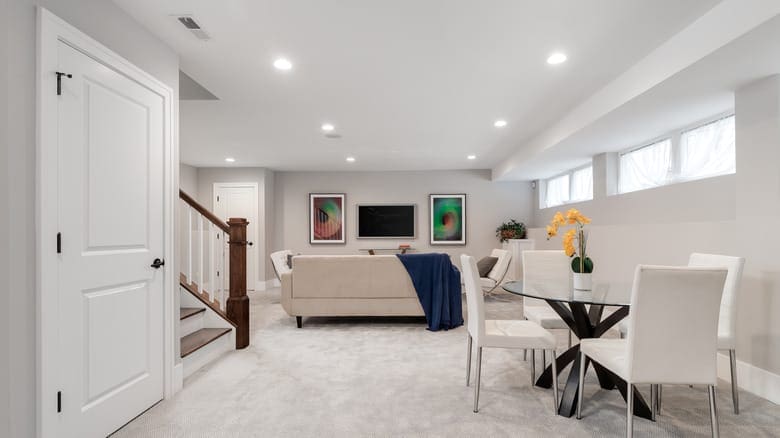
Secondary (Legal) Suites
A secondary (or legal) suite is a complete living unit with its own kitchen, sleeping area, and washroom facilities contained within another dwelling. The two dwelling units (the primary residence and the secondary suite) and any common spaces make up a single real estate entity that cannot be stratified or otherwise legally separated from the other.
Secondary suites are permitted in most single detached and some side-by-side attached houses across British Columbia and come with many benefits such as providing accommodation for aging parents, adult children or other family members, helping to pay a mortgage or investing in existing property and contributing to more long-term rental housing in communities.
Local government zoning and planning requirements, as well as certain building codes, and building permit requirements would dictate if a secondary suite can be built on a property and what building codes would apply. In the City of Vancouver (municipality), the Vancouver Building By-laws (VBBL) will apply. Elsewhere in BC, the British Columbia Building Codes (BCBC) is applicable.
There are very rigid building code and building permit requirements for converting an existing space into a secondary (or legal) suite. The newer the single-family dwelling containing the space for conversion, the easier it may be to do so. The older the single-family dwelling, the greater the number of requirements. There are also different types of secondary suites as shown in the graphic below.

Types of Secondary Suites
Secondary Suites in Port Moody – What Actually Applies
Port Moody follows the BC Building Code rather than the Vancouver Building By-Laws, and it has been more permissive than most of its neighbours for longer.
Broad zoning eligibility. Port Moody amended its Zoning Bylaw in 2004 to allow secondary suites in all single detached residential zones, with Manufactured Home Parks the exception. In 2018 it extended this to the City’s duplex zone. If you own a detached home in Port Moody, the starting assumption is that a suite is permitted – which is not the case in Port Coquitlam next door.
Small-scale multi-unit housing changes the maths. Under the provincial SSMUH framework, additional units are now possible on many Port Moody lots, and each secondary suite counts toward the unit total. If you are weighing a basement suite against a larger redevelopment, that calculation is worth doing before committing to either.
Everything is submitted online, and the permit you need depends on scope. Installing or altering plumbing fixtures or piping requires a plumbing permit; altering sanitary or storm sewers outside the building requires a separate plumbing service permit. Partial or full demolition requires a deconstruction permit.
Heritage properties have another route. Moody Centre and other older parts of the city hold significant heritage stock. A Heritage Revitalization Agreement can vary land use, density and other Zoning Bylaw regulations in exchange for conserving the building – occasionally the only way to make a project on a heritage property work.
Siting problems have two paths. A Development Variance Permit goes to Council; the Board of Variance handles minor variances where complying with siting, dimension or size rules causes undue hardship. Choosing the right one matters to your timeline.
Commercial work: Port Moody defines a tenant improvement as new construction or alteration within an industrial or commercial building, and publishes its own TI permit requirements. As a Port Moody Tenant Improvement Contractor we handle that application directly.
We work throughout Moody Centre, Glenayre, Heritage Mountain, Klahanie and Pleasantside.
For Comparison – The Stricter Vancouver Requirements
Homeowners often ask how Port Moody compares to Vancouver, where converting a basement into a legal suite is a common project. Within the municipality of the City of Vancouver, the basic guidelines for creating a secondary occupancy (legal basement) within a house includes, but is not limited to, the following:
- Suite limits: one suite per home, between 400 sq. ft. and the floor area of the main dwelling, approved through development, building and trade permits.
- Headroom and grade: 6′-6″ clear over exit routes and 80% of the suite, with the finished floor no more than 6′ below outside ground level.
- Safe exits: bedroom windows with at least 3.77 sq. ft. of clear, bar-free opening, exit doors that are never locked or blocked from outside, and a 3′-wide hard path from the street for responders.
- Fire protection: hard-wired smoke and CO alarms with battery back-up in each bedroom, linked to the main house, plus 1/2″ gypsum or sound plaster separations and self-closing solid-core connecting doors.
- Services: an electrical service large enough for both units, the specified outlets with GFCI protection near water, properly installed plumbing and gas, and a strapped hot water tank.
- Parking: on-site spaces for the full property.
As a general rule, Port Moody follows the BC Building Code, which is less restrictive than the VBBL on several of these points – and with suites permitted across all single detached zones, the question here is usually how rather than whether. Specifics will vary with the age, slope and zoning of each property, so we confirm what applies to yours before design begins.
The graphic below shows a pictorial summary of the different code requirements for secondary suites (and legal basements).

Summary of the different code requirements for secondary suites.